Reflection in C++: The Most Awaited Feature Finally Arrives!
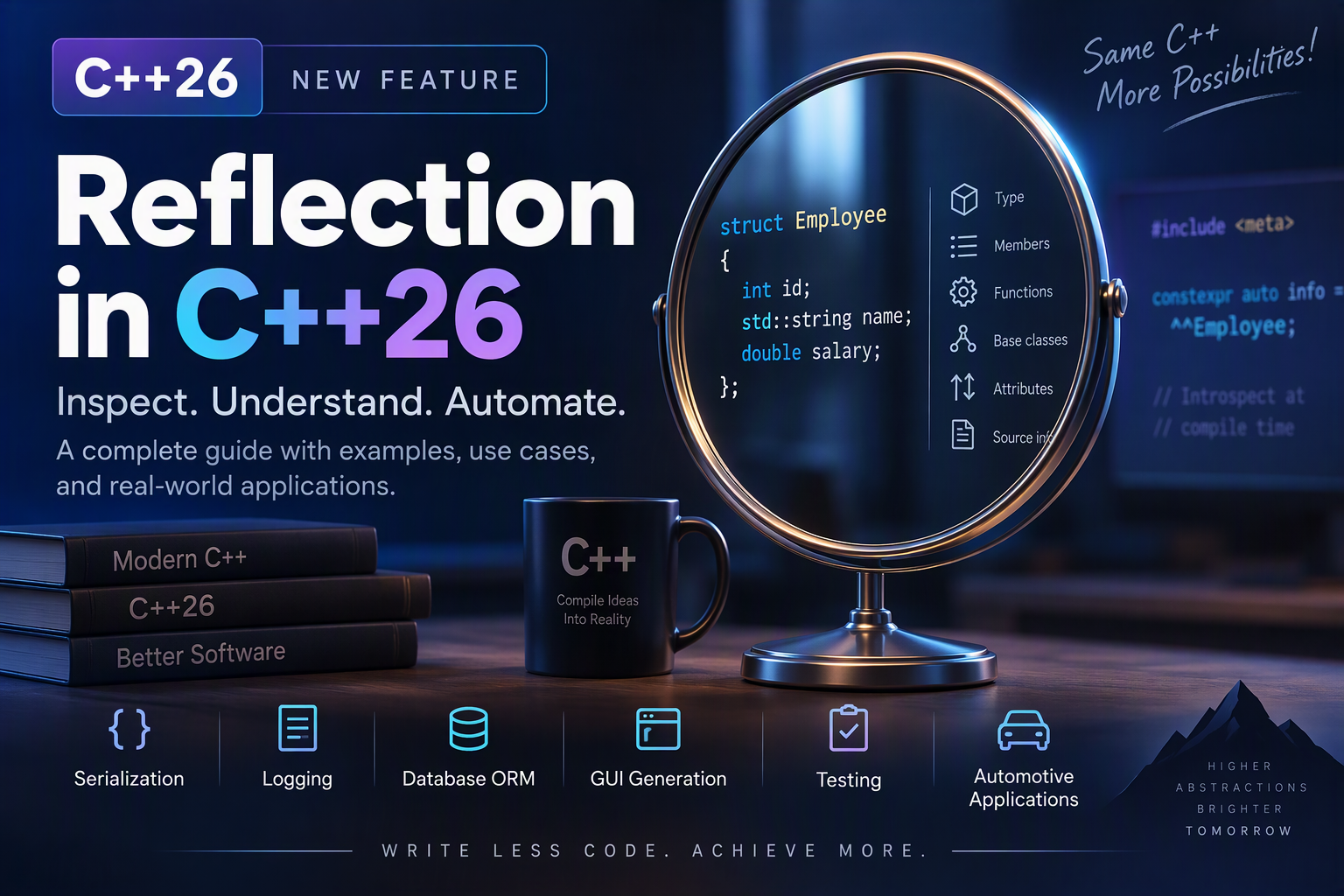
C++ has always been known for performance, control, and zero-overhead abstractions. But for many years, one feature was missing: reflection.
If you have worked with Java, C#, or Python, you already know that reflection lets a program inspect its own structure at runtime. In C++, developers long wanted similar capabilities without sacrificing performance. With C++26, that finally becomes possible through static reflection.
This article explains reflection in simple terms, why it matters, and how it can help in real-world C++ applications.
1. What Is Reflection?
Reflection is the ability of a program to inspect information about itself.
In other words, a program can ask things like:
What is the name of this class?
How many members does it have?
What are the member names?
What are their types?
What are the enum values?
For example:
struct Employee
{
    int id;
    std::string name;
    double salary;
};
The compiler already knows:
Class name:
EmployeeMembers:
id,name,salaryTypes:
int,std::string,double
But before reflection, C++ code could not easily access that metadata after compilation.
Reflection allows us to inspect the structure of our own code in a structured and reusable way.
In simple words:
Reflection means a program can examine and understand its own structure.
2. Why Was Reflection Needed in C++?
C++ is used in many performance-critical systems such as:
Game engines
Embedded systems
Automotive software
High-frequency trading
Real-time applications
Large-scale enterprise systems
These systems often need generic behavior like:
Serialization
Logging
Database mapping
GUI generation
Code generation
Validation
Conversion
Without reflection, developers had to manually write repetitive code.
For example, imagine this class:
struct Person
{
    std::string name;
    int age;
};
If you want to convert it to JSON, you might write:
std::string toJson(const Person& p)
{
    return "{ \"name\":\"" + p.name +
           "\", \"age\":" + std::to_string(p.age) +
           "}";
}
This works, but now imagine you have 20 or 100 classes. Writing serializers for each one becomes repetitive and error-prone.
Reflection solves this problem by letting the compiler provide metadata that generic code can use automatically.
3. Why Didn’t C++ Have Reflection Earlier?
C++ has always focused on:
High performance
Zero runtime overhead
Predictability
Compile-time optimization
Type safety
Traditional reflection mechanisms used in languages like Java and C# often come with:
Runtime metadata
Dynamic type checking
Extra memory usage
Bigger binaries
Performance cost
The C++ committee wanted reflection, but not at the cost of runtime performance.
That is why C++ chose static reflection instead of runtime reflection.
4. What Is Static Reflection?
There are two broad types of reflection:
Runtime Reflection
This is the kind used by Java and C#.
Example:
obj.getClass().getFields();
This happens while the program is running.
Static Reflection
This is what C++26 introduces.
This happens during compilation.
Example:
auto info = ^^Person;
The compiler inspects the type and generates metadata at compile time.
Benefits of static reflection
No runtime overhead
Better optimization
Type-safe
Compile-time validation
Works well with templates and metaprogramming
This matches the philosophy of C++ much better than runtime reflection.
5. When Was Reflection Added to C++?
Reflection was officially included in the C++26 standard through proposal P2996, titled “Reflection for C++26”.
It introduces:
Reflection operator:
^^New header:
<meta>Metadata object:
std::meta::infoCompile-time introspection support
Before C++26, C++ developers had no standard reflection support. They had to rely on:
Macros
Code generators
External libraries
Template metaprogramming tricks
Hand-written serializers
6. The Main Building Blocks
Reflection Operator
The reflection operator is:
^^
Example:
auto info = ^^int;
This gives metadata about the type int.
std::meta::info
Reflection metadata is represented by:
std::meta::info
This is like a compiler-generated metadata object that describes a C++ type or declaration.
Think of it as a structured description of the code itself.
7. A Simple Example
#include <meta>

struct Employee
{
    int id;
    double salary;
};

constexpr auto employeeInfo = ^^Employee;
Here:
^^Employee
asks the compiler:
“Give me reflection metadata for Employee.”
The compiler knows:
Employeeis a typeIt has members
idandsalaryTheir types are
intanddouble
This is the foundation for writing generic code that works with many types.
8. Why Reflection Matters So Much
Reflection is not just a cool language feature. It enables real software patterns.
1. Serialization
You can automatically convert objects to JSON, XML, YAML, or binary formats.
struct Person
{
    std::string name;
    int age;
};
You want:
{
  "name": "Satish",
  "age": 30
}
Without reflection, you must manually write conversion code. With reflection, a generic serializer can inspect the structure automatically.
2. Logging
Without reflection, logging often requires custom code:
std::cout << emp.id << "\n"
          << emp.name << "\n"
          << emp.salary << "\n";
With reflection:
logObject(emp);
This can automatically print all members.
3. ORM and Database Mapping
Reflection helps map C++ objects to database tables.
struct Employee
{
    int id;
    std::string name;
    double salary;
};
It can be mapped to a table like:
Employee (
    id,
    name,
    salary
)
This is very useful for database-backed applications.
4. GUI Frameworks
Reflection can automatically generate forms based on object members.
struct Employee
{
    int id;
    std::string name;
    double salary;
};
A GUI framework might create fields like:
ID
NAME
SALARY
without writing custom UI code for every class.
5. Generic Libraries
Reflection enables libraries to write generic logic such as:
print(obj);
serialize(obj);
clone(obj);
compare(obj);
The library can work with many different object types, even without special-case code.
9. A Real-World Example: Generic Logger
Consider a sensor project:
struct SensorData
{
    int sensorId;
    double temperature;
    double pressure;
};
Without reflection, logging might look like:
LOG(sensorId);
LOG(temperature);
LOG(pressure);
With reflection, you can write:
genericLog(sensorData);
and it can print every field automatically.
This is especially useful in:
Automotive systems
IoT devices
Industrial control systems
Telemetry platforms
10. A Real-World Example: Automotive Diagnostics
In automotive software, diagnostic structures are common.
struct DTCInfo
{
    int code;
    std::string description;
    bool active;
};
Reflection can be used to:
Log every field
Serialize diagnostic payloads
Send data over communication buses
Generate reports automatically
This reduces manual work and improves maintainability.
11. C++ Reflection and JSON Serialization
One of the biggest motivations behind reflection is JSON serialization.
Example:
struct Employee
{
    int id;
    std::string name;
    double salary;
};
Desired output:
{
  "id": 101,
  "name": "Satish",
  "salary": 50000
}
Without reflection, this requires manual code. With reflection, the structure can be inspected and serialized generically.
This is one of the most practical uses of reflection.
12. Advantages of Reflection in C++
Less Boilerplate
Before reflection, you might need:
100 serializers
100 loggers
100 conversion functions
After reflection, you may only need:
1 generic serializer
1 generic logger
1 generic converter
Easier Maintenance
If you add a new member:
std::string department;
you do not need to rewrite all serializers or loggers manually.
Better Generic Libraries
Reflection makes it easier to build:
JSON libraries
XML libraries
Database mappers
Testing tools
GUI data-binding systems
Compile-Time Safety
Static reflection works at compile time, so many errors are caught early.
Zero Runtime Overhead
This is a big win for C++. Reflection is resolved during compilation instead of adding runtime dynamic behavior.
13. Limitations
Reflection does not mean:
std::string field = "salary";
obj[field] = 5000;
like Python or JavaScript.
C++ reflection is primarily compile-time reflection, which preserves:
Performance
Type safety
Optimization opportunities
Predictability
It is not intended to turn C++ into a fully dynamic scripting language.
14. Why Static Reflection Is the Right Fit for C++
C++ values performance and control. That is why static reflection is such a great match.
It gives us the benefits of metadata introspection without:
expensive runtime type checks
unnecessary memory overhead
dynamic dispatch complexity
loss of compiler optimization
This is exactly why static reflection was the right design choice for C++26.
15. Example: Regular C++ Without Reflection
#include <iostream>
#include <string>

struct Employee
{
    int id;
    std::string name;
    double salary;
};

int main()
{
    Employee emp{101, "Satish", 85000.0};

    std::cout << "Employee Information\n";
    std::cout << "---------------------\n";
    std::cout << "Id : " << emp.id << '\n';
    std::cout << "Name : " << emp.name << '\n';
    std::cout << "Salary : " << emp.salary << '\n';
}
Output:
Employee Information
---------------------
Id : 101
Name : Satish
Salary : 85000
This works fine, but you must manually code each field access.
With reflection, compilers and libraries can automate these operations in a generic way.
16. Interview Questions on Reflection in C++
What is reflection?
Reflection is the ability of a program to inspect and reason about its own structure and metadata.
When was reflection introduced in C++?
Reflection was introduced as part of C++26.
What is the reflection operator?
The reflection operator is:
^^
What problem does reflection solve?
It reduces boilerplate code for:
Serialization
Logging
ORM mapping
GUI generation
Generic libraries
Why static reflection instead of runtime reflection?
Because C++ values:
Zero runtime overhead
Compile-time optimization
Type safety
Performance
17. Final Thoughts
Reflection in C++ is one of the most important language features added in recent years.
It solves real software problems:
Repetitive serialization code
Manual logging
Database object mapping
GUI generation
Reusable generic libraries
Most importantly, it does this without sacrificing C++’s core strengths:
Speed
Performance
Type safety
Compile-time optimization
This is why reflection in C++ is such a big deal.
It brings modern productivity to C++ while maintaining the language’s philosophy.
If you work on large-scale C++ systems, reflection is definitely a feature to watch closely.
Conclusion
Reflection in C++ is not just a language curiosity. It is a practical feature that enables cleaner, more maintainable, and more generic code.
From serialization to logging, database mapping to GUI generation, reflection helps reduce boilerplate while keeping C++ fast and safe.
With C++26, C++ finally gets a standard reflection mechanism, and this is a major step forward for the language.