C++26 Contracts Explained: The Feature C++ Developers Have Waited Decades For
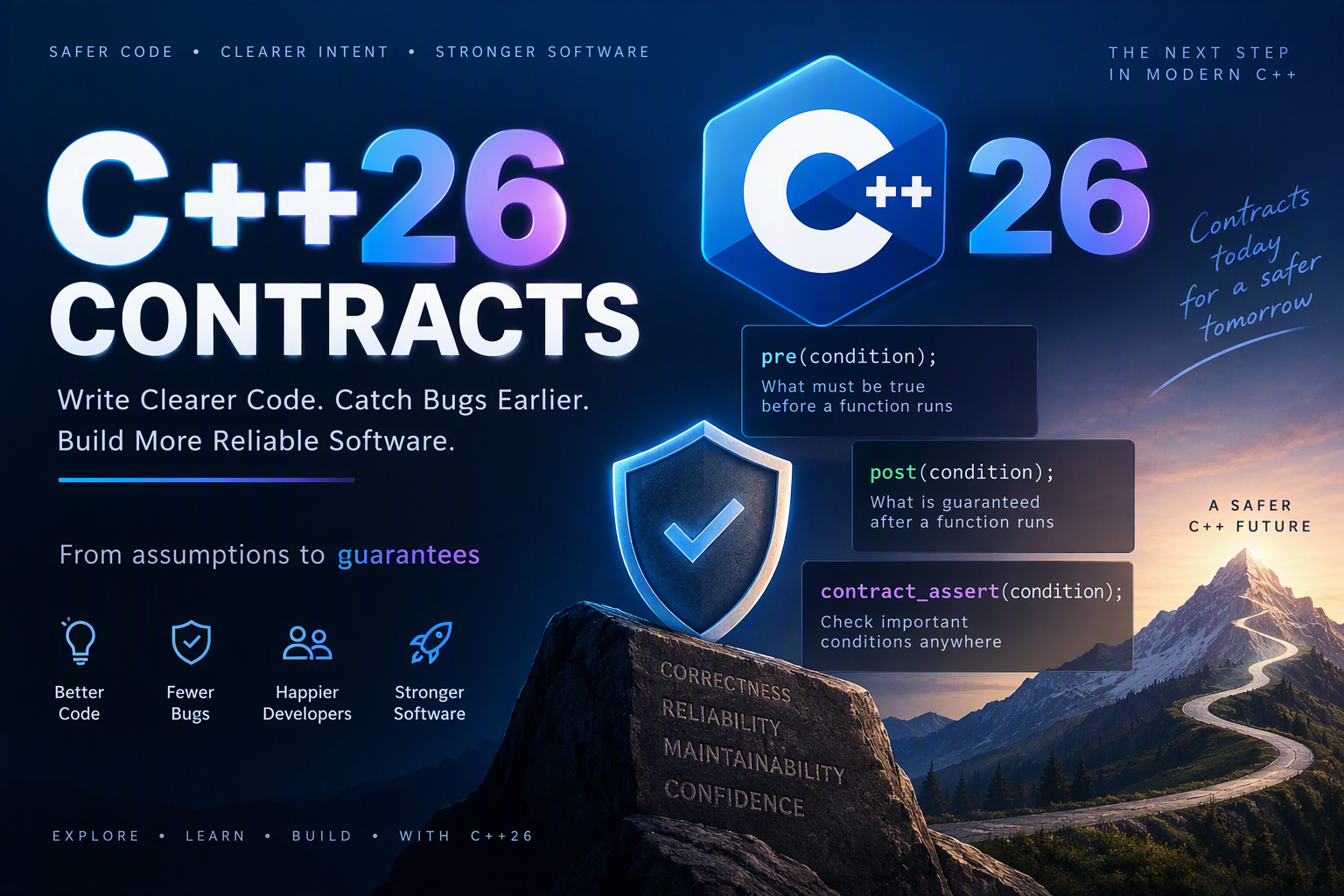
C++26 Contracts: Finally, Native Design-by-Contract Arrives in Modern C++
Introduction
For decades, C++ developers have relied on comments, documentation, assertions, code reviews, and defensive programming to express expectations about how functions should be used. The problem is that comments can become outdated, documentation can be ignored, and assertions are often disabled in release builds.
C++26 introduces Contracts, a language-level feature that allows developers to formally specify preconditions, postconditions, and runtime correctness expectations directly in code.
This article explains Contracts from scratch, why they were added, the problems they solve, practical use cases, and how you can start using them.
What Are Contracts?
A contract is an agreement between a function and its caller.
A contract explicitly states:
What must be true before a function is called (Precondition)
What must be true after a function completes (Postcondition)
What conditions must always remain true during execution (Assertions)
Think of contracts as executable documentation.
Instead of writing:
// Caller must pass a positive value.
int squareRoot(int x);
You can write:
int squareRoot(int x)
    pre(x >= 0);
Now the expectation becomes part of the language itself.
When Were Contracts Added to Standard C++?
Contracts are part of C++26 and are specified as Contract Assertions.
The feature was accepted through WG21 proposal P2900 and appears in the C++26 working draft.
References:
Why Did C++ Need Contracts?
Before C++26, developers generally used one of these approaches:
1. Comments
// age should be >= 18
void registerUser(int age);
Problem:
Compiler cannot verify it.
Caller may ignore it.
2. Runtime Checks
if(age < 18)
{
    throw std::invalid_argument("Invalid age");
}
Problem:
Boilerplate code everywhere.
Intent gets mixed with business logic.
3. assert()
assert(age >= 18);
Problem:
Often disabled in release builds.
Not part of function interface.
Contracts solve all these issues by making expectations explicit and standardized.
Problems Contracts Solve
Problem #1: Hidden Assumptions
Without contracts:
double divide(double a, double b)
{
    return a / b;
}
Does the caller know that b must not be zero?
Not necessarily.
With contracts:
double divide(double a, double b)
    pre(b != 0)
{
    return a / b;
}
The requirement is visible immediately.
Problem #2: Better API Documentation
Contracts make APIs self-documenting.
void withdraw(double amount)
    pre(amount > 0);
Every reader instantly understands the expectation.
Problem #3: Earlier Bug Detection
Many production bugs occur because callers provide invalid inputs.
Contracts detect violations closer to the source of the problem.
Problem #4: Reduced Defensive Programming
Instead of writing repetitive validation code throughout an application, developers can express requirements declaratively.
Core Building Blocks
1. Preconditions
A precondition defines what must be true before the function executes.
int divide(int a, int b)
    pre(b != 0)
{
    return a / b;
}
Meaning:
"The caller is responsible for ensuring b is not zero."
2. Postconditions
A postcondition defines what must be true after execution.
int absoluteValue(int value)
    post(result : result >= 0)
{
    return value < 0 ? -value : value;
}
Meaning:
"The function guarantees the returned value is never negative."
3. contract_assert
Used inside a function body.
void sortData(std::vector<int>& data)
{
    std::ranges::sort(data);

    contract_assert(std::ranges::is_sorted(data));
}
This verifies an important assumption during execution.
Easy Example: Bank Account Withdrawal
Without Contracts
class BankAccount
{
public:
    void withdraw(double amount)
    {
        if(amount <= 0)
        {
            throw std::runtime_error("Invalid amount");
        }

        balance -= amount;
    }

private:
    double balance{1000};
};
With Contracts
class BankAccount
{
public:
    void withdraw(double amount)
        pre(amount > 0)
    {
        balance -= amount;
    }

private:
    double balance{1000};
};
The code becomes cleaner and the intent becomes obvious.
Real-World Use Cases
Financial Systems
void transfer(double amount)
    pre(amount > 0);
Ensures invalid transactions never start.
Automotive Software
void setVehicleSpeed(int speed)
    pre(speed >= 0)
    pre(speed <= 250);
Useful in safety-critical systems.
Embedded Systems
void writeBuffer(std::span<char> data)
    pre(!data.empty());
Prevents invalid memory operations.
Networking
void connect(int port)
    pre(port > 0)
    pre(port <= 65535);
Avoids invalid configuration bugs.
Contracts vs assert()
assert(ptr != nullptr);
versus
void process(Data* ptr)
    pre(ptr != nullptr);
Advantages of Contracts:
Part of the public interface
Standardized behavior
Self-documenting APIs
Better tooling support
Can participate in contract violation handling
How Contracts Make Life Easier
For API Designers
Requirements become explicit.
For Code Reviewers
Hidden assumptions become visible.
For Test Engineers
Expected behavior is easier to verify.
For New Team Members
Contracts significantly reduce onboarding effort.
For Large Projects
Contracts act as living documentation that remains close to the implementation.
Complete Example
#include <iostream>

int divide(int numerator, int denominator)
    pre(denominator != 0)
    post(result : result <= numerator)
{
    return numerator / denominator;
}

int main()
{
    std::cout << divide(20, 4) << '\n';
}
What this contract says:
Caller must not pass zero.
Function guarantees the postcondition.
Violations are handled through the C++ contract mechanism.
Will Contracts Replace Exceptions?
No.
Exceptions and contracts solve different problems.
Use Contracts when:
Caller violates API rules.
A programming error occurs.
Preconditions are broken.
Use Exceptions when:
External failures occur.
Network issues happen.
Files are missing.
Databases are unavailable.
Things to Remember
Contracts are not a replacement for input validation.
Contracts express programmer assumptions.
Contracts improve readability.
Contracts help find bugs earlier.
Contracts provide executable documentation.
Contracts are one of the most anticipated language-level correctness features added to modern C++.
Final Thoughts
C++26 Contracts bring Design by Contract directly into the language. Instead of scattering checks across codebases or relying solely on documentation, developers can now formally state expectations and guarantees in a way that is readable, maintainable, and tool-friendly.
For large-scale systems such as Automotive, Embedded, Finance, Cloud, and Distributed Applications, Contracts can become a powerful mechanism for improving code quality and reducing defects.
As compiler support matures, Contracts may become one of the most impactful C++ features for building reliable software.
Sources
Cppreference - Contract Assertions (C++26) https://cppreference.com/cpp/language/contracts
WG21 C++ Standard Papers (P2900) https://www.open-std.org/